
Toilet Overflowing and Won't Stop? Do These 3 Things First
The water is climbing, the bowl is already at the brim, and every second feels like the moment it spills onto the floor. The good news is that you can stop the rise faster than you think, and you do not need a single tool to do it. The first thirty seconds matter more than anything else that follows, so this guide walks the emergency shut-off first, then the why, then the fixes.
Stop the Water First
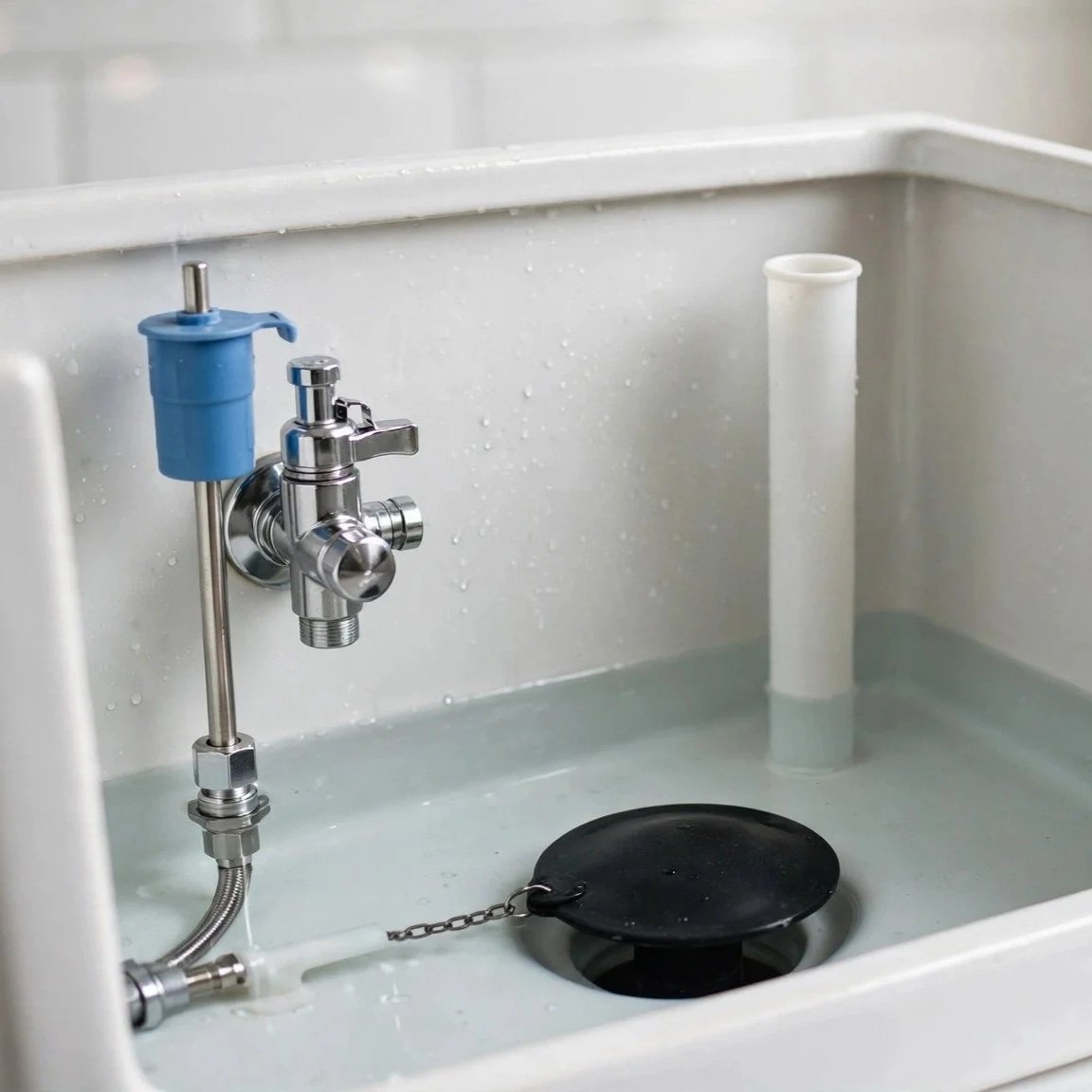
Before you look for a plunger or grab towels, cut the flow. Two water sources are feeding an overflow, and you can shut both from the tank.
Push the flapper down: Take the lid off the tank and set it somewhere safe, because it is porcelain and cracks easily. Inside, at the bottom, is a rubber or plastic flap covering a large opening. That flap is the flapper, and when the handle is pressed, it lifts to send tank water into the bowl. Reach in and press it firmly back down onto its seat. The tank water is clean, so this is the least unpleasant part of the whole job.
Lift the float to stop the refill: With the flapper closed, the fill valve on the left side will try to refill the tank, and a bowl that is already backed up will keep rising. Find the float, either a ball on an arm or a cup that slides on the fill tube, and lift it. Raising the float tells the valve the tank is full, and the water stops running.
Close the shut-off valve: If lifting the float does not settle things, or you would rather not stand there holding it, go to the wall behind the base. A small oval or football-shaped handle sits on the supply line where it meets the floor or wall. Turn it clockwise, all the way, until it stops. That isolates the toilet from the house supply, and nothing more can enter the bowl. If the valve is stiff or seized from years of hard-water scale, do not force it hard enough to snap it; holding the float remains your fallback.
Once the water is still, take a breath. The emergency is over. What is left is a diagnosis and a cleanup.
Why a Toilet Overflows
An overflow means water is entering the bowl faster than it can leave, and the reason falls into one of two buckets.
The common one is a blockage. A toilet drains through a curved internal channel called the trap, then into a branch drain, and the trap is the narrowest point in the whole path. Too much paper, a flushed wipe that never breaks down, a child's toy, or a slug of hardened waste lodges in the trap or just past it. Water piles up behind the obstruction with nowhere to go.
The second bucket is a fill valve that never shuts off. If the flapper leaks or the float is set too high, the tank keeps feeding the bowl in a slow trickle, and a partial clog that would otherwise drain fine slowly loses the race. This is the quieter overflow, the one that soaks a bathroom overnight rather than in a dramatic thirty seconds.
There is a third, more serious signal worth naming now. Every drain in a home breathes through a vent pipe that runs up through the roof. When that vent is blocked, drains gurgle and empty slowly across the house, and a toilet that keeps backing up may be starved of air rather than jammed with debris.
Clear a Local Clog With a Plunger
If only this one toilet is misbehaving and the water level has dropped a little on its own, the clog is local, and you can likely clear it yourself.
Use the right plunger. The flat rubber cup sold for sinks does almost nothing on a toilet. You want a flange plunger, the kind with a soft rubber sleeve that folds out from the cup. That sleeve seats into the toilet's drain opening and forms the seal that actually moves water.
Seat it and work it: Slide the flange into the drain hole so the cup covers it completely. There should be enough water in the bowl to submerge the rubber, because you are pumping water, not air, and water transmits the force that breaks a clog loose. Press down gently on the first push to squeeze out trapped air, then pump firmly and steadily ten to fifteen times, keeping the seal the whole time. Pull up sharply on the last stroke. If the water suddenly drains, you have won.
A stubborn clog can take several rounds. Refill the bowl partway between attempts if the water drops too low to cover the cup. Resist the urge to reach for a chemical drain cleaner; more on that below.
When You Need an Auger
If plunging does not move it after a few honest tries, the blockage is deeper or more solid than suction can handle. This is the job for a closet auger, sometimes called a toilet snake.
A closet auger is a coiled cable inside a curved metal tube, built specifically for toilets. The curve protects the porcelain, and a plastic boot at the tip keeps the cable from scratching the visible bowl. You feed the cable into the drain, crank the handle to push it through the trap, and either break the clog apart or hook it and pull it back out. A hand-cranked auger reaches roughly three to six feet, which covers the trap and the start of the branch drain, the two spots where most clogs sit.
If the auger reaches its full length and still finds resistance, the problem is past the fixture and out in the household drain lines. That is the moment to stop and reassess.
Local Clog or Main-Line Backup
Telling these two apart decides whether this is a five-minute fix or a call for help.
A local clog affects only the toilet. Other drains run fine, the tub empties, the sink gurgles, nothing backs up, and clearing the trap solves it.
A main-line problem shows itself everywhere downstream. The classic sign is other fixtures reacting when you use water: flush the toilet and the tub drain bubbles, run the bathroom sink and water rises in the toilet, or the shower base fills when the washing machine drains. When multiple fixtures back up together, the blockage sits in the main line that carries everything to the sewer, and no plunger or closet auger reaches that far.
Treat a multi-fixture backup as a stop sign. Quit running water anywhere in the house, because every gallon you send down has to come back up through the lowest drain, often a shower or floor drain. If what is surfacing looks or smells like sewage, keep everyone clear of it and call a plumber; this is a job for a powered main-line machine or a camera inspection, not a hand tool.
Clean Up Safely
Overflow water that has touched the drain is not clean water, even if it looks clear. Treat it as contaminated.
Put on rubber gloves and open a window or run the exhaust fan before you start, so the room ventilates while you work. Sop up standing water with old towels or a wet-dry vacuum rather than the good bath linens, and bag anything you cannot launder in hot water. Once the floor is dry, sanitize every surface the water reached, the tile, the base of the toilet, the bottom of the vanity, with a disinfecting cleaner, and let it sit the full contact time listed on the label before wiping.
One safety line that matters: if the water spread far enough to reach an electrical outlet or a plugged-in device, do not step into it to reach the plug.
WARNING: Overflow water that has touched the drain is not clean water, even if it looks clear, so treat it as contaminated. If the water spread far enough to reach an electrical outlet or a plugged-in device, do not step into it to reach the plug. Shut power to that part of the house at the breaker first, then deal with the water.
Prevent the Next One
A toilet that clogged once will clog again if nothing changes.
Flush only what dissolves. Human waste and toilet paper break down in water, and almost nothing else does. Wipes labeled flushable are the single most common culprit behind repeat clogs, along with paper towels, cotton products, and dental floss, none of which come apart the way toilet paper does. A small covered bin next to the toilet ends most of these problems.
Go easy on the paper. If your household favors thick multi-ply paper, a double flush partway through a large amount moves it out before it can bunch up in the trap.
Skip liquid drain cleaners in a toilet entirely. They are formulated for pipes, not for a porcelain bowl full of standing water, and they can sit against the trap without ever reaching the clog, splash back when you plunge, and damage the seals inside the toilet. A plunger or a closet auger is both safer and more effective.
If you have a plunger, keep the flange kind within reach of every toilet. The middle of an overflow is a bad time to discover you own the wrong shape.
An overflowing toilet feels like a disaster, but almost every one comes down to a simple sequence: stop the water at the flapper, float, or valve, figure out whether one fixture or the whole line is involved, then clear it or call it. Handle the first thirty seconds calmly, and the rest is just cleanup.
Frequently Asked Questions
Can I pour hot water down the toilet to clear a clog?
Why does my toilet bubble when I run the bathroom sink?
How long can I leave the shut-off valve closed?
Will one bad flush overflow again if I flush right away?
Is a flushed object like a toy something I can get out myself?
Does hard water make my toilet more likely to overflow?
Save this before the next overflow — a fast diagnosis beats a flooded floor. Much Better Plumbing serves Las Vegas and Clark County. Call (702) 996-4760.