
How to Shut Off Your Water Fast Before a Pipe Floods Your Home
A pipe does not wait for a convenient moment to fail. It lets go behind a wall at 2 a.m., or a supply line under the sink pops loose while you are at work, and water keeps arriving at full pressure until someone closes a valve. The difference between a mopped floor and a ruined ceiling often comes down to a single question: does anyone in the house know how to stop the water, and can they do it in the dark, fast, without hunting for the right handle?
Most people find out they do not know the answer during the emergency itself. The valve is behind a stack of storage bins, the handle is painted shut, or nobody realizes there is more than one place to cut the flow. The fix is not complicated, but it has to happen before the crisis. Locate your shutoffs, learn which type you have, and turn them once so they are not seized. That short bit of homework is what keeps a small failure from becoming a flooded floor.
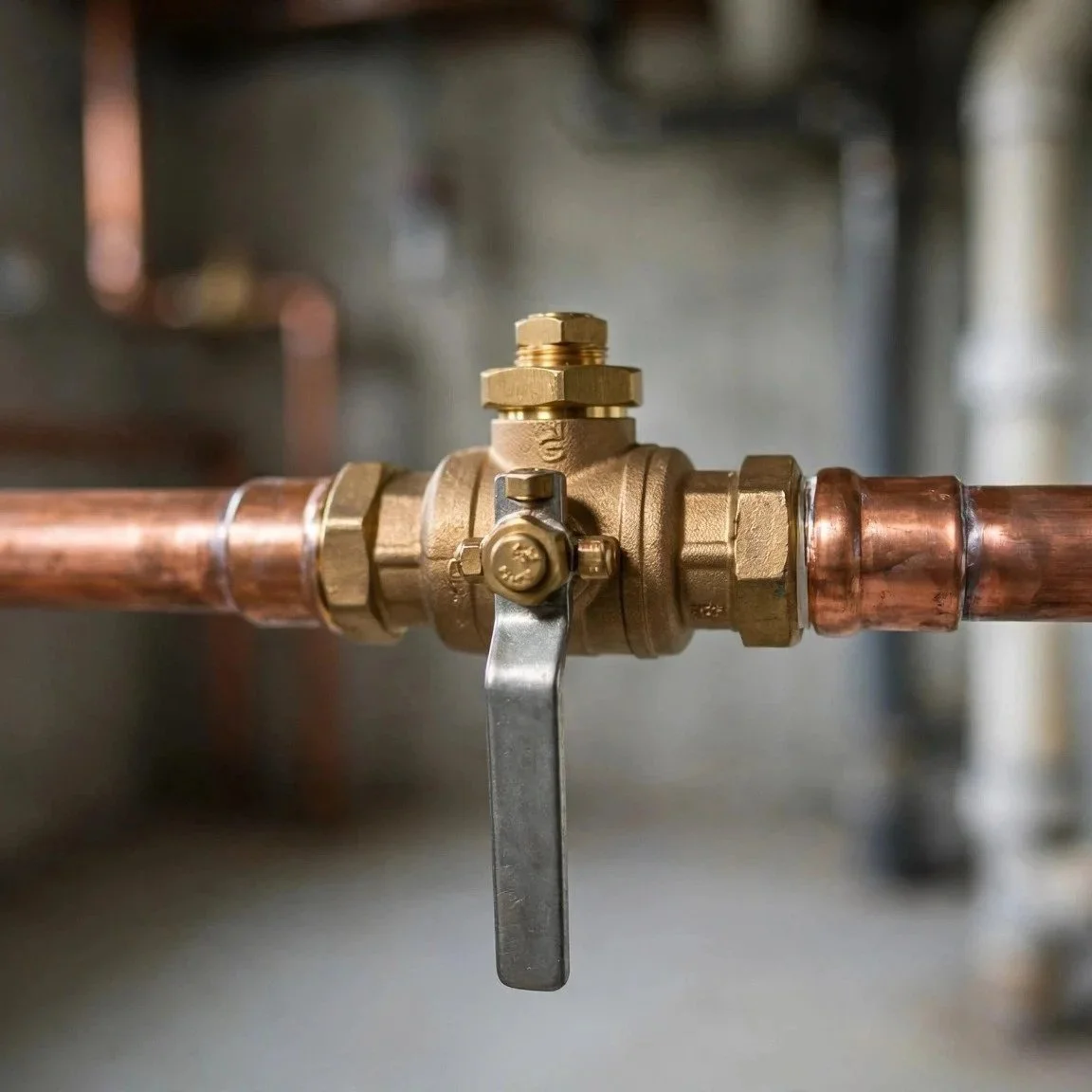
The Three Layers of Shutoffs in Your Home
Your plumbing does not give you one on/off switch. It gives you a layered set, and knowing which layer to reach for saves time and spares you from cutting water to the whole house when you do not have to.
The first layer is the fixture stops, the small local valves at each sink, toilet, and appliance. The second is the main shutoff, the single valve that controls water to the entire house. The third is the street or curb valve out at the meter, which belongs to the water utility and is a genuine last resort. A dripping toilet supply line calls for the first layer. A pipe spraying inside a wall calls for the second. You almost never touch the third yourself.
Fixture and Local Shutoff Valves
Under most sinks you will find one or two small oval or football-shaped handles on the supply lines feeding the faucet. Behind a toilet, look low on the wall where the supply line meets the tank; there is usually a single stop there. The water heater has its own shutoff on the cold inlet at the top of the tank, and the washing machine has a pair of valves (hot and cold) where its hoses connect, often in a recessed box in the wall.
Reach for these when the problem is confined to one fixture. A leaking faucet, a running toilet, a supply line weeping at the connection- these are all single-fixture problems. Close the local stop, and the rest of the house keeps its water. That means you can shut off the leaking toilet and still wash your hands at the kitchen sink while you wait for the repair.
Turn them the right way: Most fixture stops are the round multi-turn kind: righty-tighty, so clockwise closes. Turn gently. These small valves sit unused for years and can be stiff. If one will not budge with reasonable hand pressure, stop and go to the main instead of forcing it.
Where to Find the Main Shutoff
The main shutoff sits close to where the water supply line enters the house, on the interior side. Walk the perimeter of the lowest level and look for the point where a pipe comes up through the floor or in through a wall. Common spots: a basement, a crawlspace, an attached garage, or a utility area near the furnace. In some homes it lives right next to the water heater, since that is often near the entry point. Some houses, especially those built on slabs in milder regions, have the main on an outside wall or in a recessed box near the front hose bib.
Finding it is a five-minute task on a calm afternoon and a frantic hunt during a flood, so do it now. Trace from the water meter if you have one indoors, because the main is almost always the first valve on the house side of that meter. Once you find it, you have found the one valve that stops water to every fixture at once.
The Two Valve Types and How to Close Each
Nearly every main shutoff is one of two designs, and they close differently. Look at the handle before you need to act.
Gate valve: This has a round handle, like a small wheel or a faucet knob. Inside, a wedge lowers to block the pipe. To close it, turn the wheel clockwise, and keep turning; a gate valve takes several full rotations to seat fully, not a quick flick. Gate valves are common in older homes and are the type most likely to seize or leak with age.
Ball valve: This has a straight lever handle. Inside is a ball with a hole through it that lines up with the pipe when open. To close it, swing the lever a quarter turn until it sits perpendicular, crosswise to the pipe. Handle parallel with the pipe means open; handle across the pipe means closed. A ball valve is fast, which is exactly what you want in an emergency.
If your main is a gate valve and it fights you, do not throw your weight into it. The wedge and stem can corrode, and an old gate valve can snap off in your hand, turning one leak into two. Ease it, and if it will not move, call a plumber to replace it before an emergency forces the issue.
The Street Valve and the Meter
Out at the property line, usually in a covered box set into the ground, sits the curb or street valve. This is the utility's shutoff, the one they use to disconnect service. It generally needs a meter key, a long T-handled tool that reaches down into the box and fits the valve's operating nut. A regular wrench rarely works and can round off the nut.
Treat this valve as a last resort, for when your interior main is broken, missing, or seized and water is still pouring in. Lift the lid carefully (spiders and standing water are common), fit the key, and turn slowly. The meter itself is utility property, and damaging it can leave you responsible for the repair, so work gently and never wrench on the meter body. If you reach the point of needing the curb valve, you are also at the point of calling both a plumber and, if the meter is involved, the water provider.
What to Do the Moment a Pipe Bursts
When water is actively flooding, the order of operations matters more than speed alone.
First, protect against shock: If water is spreading toward outlets, a furnace, a water heater, or any appliance, cut power at the breaker panel before you wade in. Standing water around energized equipment is a shock hazard, and the few seconds it takes to flip the main breaker are worth it. If the panel itself is in the wet area and you cannot reach it safely, stay out and call for help.
Second, close the main: Get to that main shutoff you already located and close it fully, several turns for a gate valve or a firm quarter turn for a ball valve. This stops new water from arriving.
Third, drain the pressure: Open a faucet at the lowest point in the house, a basement laundry tub or a ground-floor tub, and open outdoor hose bibs if handy. This bleeds the water still sitting in the pipes and eases pressure at the break, so the leak slows to a trickle instead of a spray.
Fourth, call a plumber: With the water stopped and pressure relieved, you have bought time. Pull towels, move valuables, and get a professional out to repair the failure and check for hidden damage. A shutoff at the water heater or a gas appliance also means cutting that unit's own power or gas supply before anyone works on it.
Test the Main So It Is Not Seized
A shutoff valve that has never been turned is a valve you cannot trust. Mineral scale and corrosion build up around the stem, and a gate valve in particular can freeze in the open position or refuse to seal all the way. Twice a year, turn the main fully off, then back on, and watch for two things: does it move without a fight, and does the water actually stop when it is closed?
Label It So Everyone Knows
The person home during the emergency might be a teenager, a houseguest, or a partner who has never given the plumbing a second thought. Knowing where the main is does no good if the knowledge lives in only one head.
Tie a bright tag to the main shutoff that reads "MAIN WATER SHUTOFF" and notes which way closes it. Put a magnet on the fridge or a note in the phone with the location and the same instruction. Walk every capable member of the household to the valve once and have them close and open it themselves, because reading about a quarter turn is not the same as having done it. Do the same for the water heater and washer valves. Five minutes of this turns a panic into a procedure.
Frequently Asked Questions
How fast does water actually escape from a burst pipe?
Can freezing weather affect where I should keep the main shutoff accessible?
My main shutoff handle is missing or broken. What now?
Does turning off the main also stop my water heater from working?
Should I shut off water to the whole house before a long vacation?
Why does my water keep running a little after I close the main?
Find and test your main shutoff today, then save our number for the leak you cannot stop yourself — a five-minute drill now spares you a flooded floor later. Much Better Plumbing serves Las Vegas, Summerlin, and Henderson. Call (702) 996-4760.