
Pipe Burst? What to Do Before the Plumber Arrives
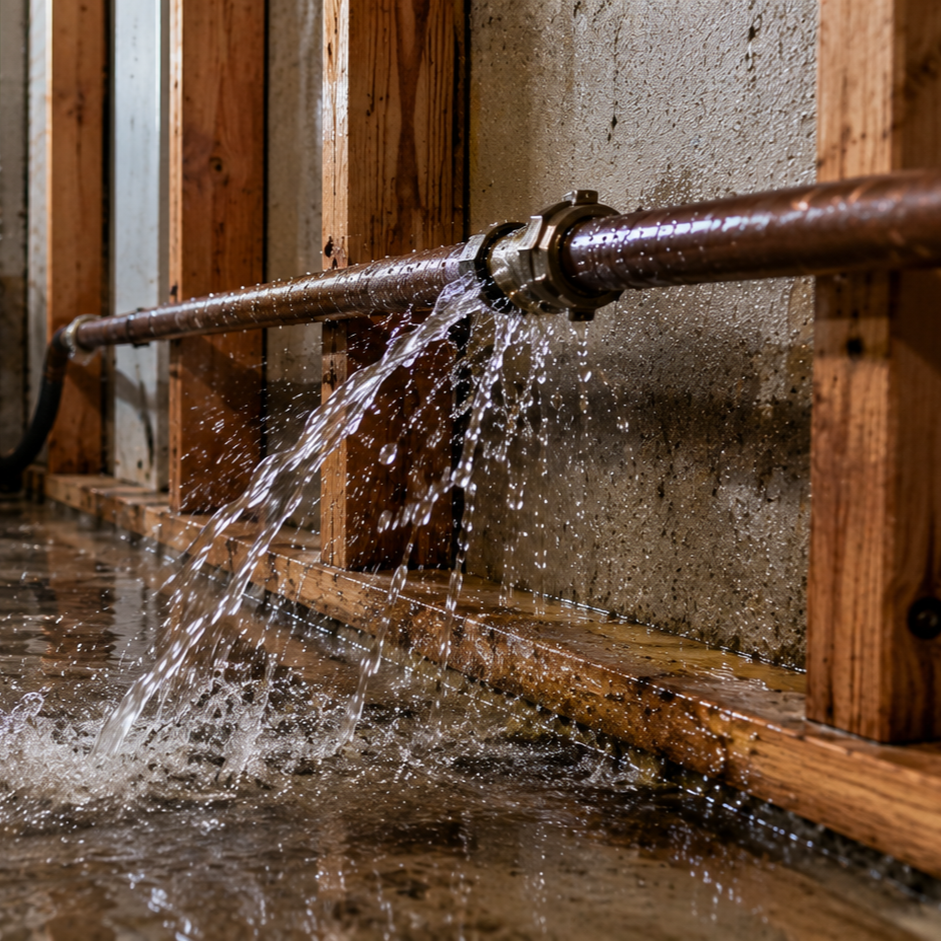
You hear it before you see it: a hiss behind the wall, then a patter that turns into a rush, and by the time you round the corner, there's water spreading across the floor and soaking into the baseboard. A burst pipe doesn't wait for a good time. Water damage is one of the most common home insurance claims there is — and what you do in the next five minutes matters more than anything the plumber does in the next five hours. Move in this order.
Shut Off the Main Water Valve Right Away
Every gallon that reaches the floor came through one valve, and closing it stops the flood at the source. Your main shutoff is usually where the water line enters the house — in a garage, a utility closet, or an outdoor box near the foundation. A lever-style (ball) valve closes with a quarter turn; a round-handle gate valve turns clockwise until it stops.
This is the one step worth knowing cold before anything goes wrong. Find your main valve today, while the floor is dry, and make sure it actually turns. Older gate valves can corrode and seize if they've sat untouched for years, and the moment you need it is the worst time to discover it won't budge.
If you really can't locate or move the main valve, look for the smaller shutoff closest to the leak — under a sink, behind the toilet, or on the water heater's supply line. It won't stop water from getting to the whole house, but it can choke off the broken line while you deal with the rest. When the crisis is over, a working main valve and good leak detection are worth sorting out properly.
Cut the Power to Any Wet Area
Water and electricity in the same room is the part of this that can actually hurt you. If the leak is anywhere near outlets, light fixtures, or an electrical panel — or if water is spreading toward them — switch off the breakers to that part of the house at the panel.
Here's the catch worth respecting: if reaching the panel means walking through standing water, don't. Wet floors and electrical panels are exactly the combination to avoid. Call the power company or wait for the plumber rather than wading in.
Open the Faucets and Drain the Lines
With the main valve closed, there's still pressurized water sitting in the pipes, and it will keep pushing out of the break until it's gone. Open every cold-water faucet in the house and flush the toilets once. That bleeds the remaining pressure and pulls the leftover water down through the taps instead of out through the crack.
Open the hot taps too, but switch off your water heater first — gas to "pilot," or the breaker for an electric unit. Draining the system while the heater keeps firing on an empty or half-full tank can dry-fire the element or stress the tank. If the burst is on the hot side or near the heater, that unit may need a look anyway; this is the moment to plan for water heater service.
Contain the Water and Protect What You Can
Now you're working against the clock, because moisture is what does the lasting damage. Throw down towels and buckets, push water toward a drain or door, and get a wet/dry vacuum on it if you have one. A pipe-repair clamp or even a rag-and-hose-clamp wrap from the hardware store can slow the leak itself once the water is off.
Lift what you can off the floor. Rugs, electronics, the bottom drawer of a dresser, cardboard boxes in the garage — anything porous either soaks up water or wicks it upward like a paper towel standing in a spill. Slide furniture legs onto foil or wood blocks so they don't stain or swell. Speed matters here for a specific reason: given a damp surface and no drying, mold can take hold within 24 to 48 hours, so the goal is to get things dry, not just mopped.
What to Check Once the Flood Is Stopped
Once the water's off and the lines are drained, a quick scan tells you and the plumber what you're dealing with. Match what you're seeing to the likely cause and how fast it needs attention.
| What you find | Likely cause | What it means |
|---|---|---|
| Pinhole spray on a copper line | Corrosion from hard-water minerals | Spot repair now; the rest of that line is aging too |
| Burst at a threaded joint or fitting | Pressure stress or a failed connection | Re-make the joint; check house pressure |
| Warm spot on the slab, no visible pipe | Slab leak under the foundation | Needs leak detection — don't wait on this one |
| Water staining a ceiling below a bathroom | Supply or drain line failure upstairs | Stop using that fixture until it's inspected |
Why Burst Pipes Happen Here
In a freezing climate, the usual villain is ice — water expands as it freezes and splits the pipe. Around the Las Vegas Valley, that's rarely the story. Here, it's two slower forces. The first is hard water: local supply is drawn mostly from the Colorado River and runs about 16 grains per gallon (roughly 280 parts per million), which leaves calcium and magnesium scale that narrows pipes and eats at older copper until a pinhole opens. The second is water pressure. Plumbing code calls for a pressure-reducing valve once household pressure passes 80 psi, and pressure living above that line fatigues fittings and shortens the life of every connection in the house, which is why a pressure regulator is a common fix after a failure.
There's also the slab. Most Valley homes sit on a concrete slab with the supply lines run beneath it, so a failure underground shows up as a warm patch on the floor or an unexplained jump in the water bill rather than an obvious spray. A regulator and a water softener won't undo a break that's already happened, but along with a whole-home repipe on aging lines, they're what keep the next one from forming.
Frequently Asked Questions
How do I find my main water shutoff valve?
Should I turn off the water heater during a burst pipe?
Is a burst pipe covered by homeowners’ insurance?
How much water comes out of a burst pipe?
Can I just patch the pipe myself until the plumber comes?
Act Fast, Then Call the Pro
When a pipe bursts, the first minutes matter most: shut off the water at the main, open faucets to relieve pressure, cut the power if water is near electrical, and start moving water and belongings out of harm's way. Those steps limit the damage while you wait. A temporary clamp can slow a small leak, but the burst pipe still needs a proper repair — so once the water's off and the mess is contained, get a plumber out to fix it right.