
Tankless vs Tank Water Heater: Which Is Right for Your Home?
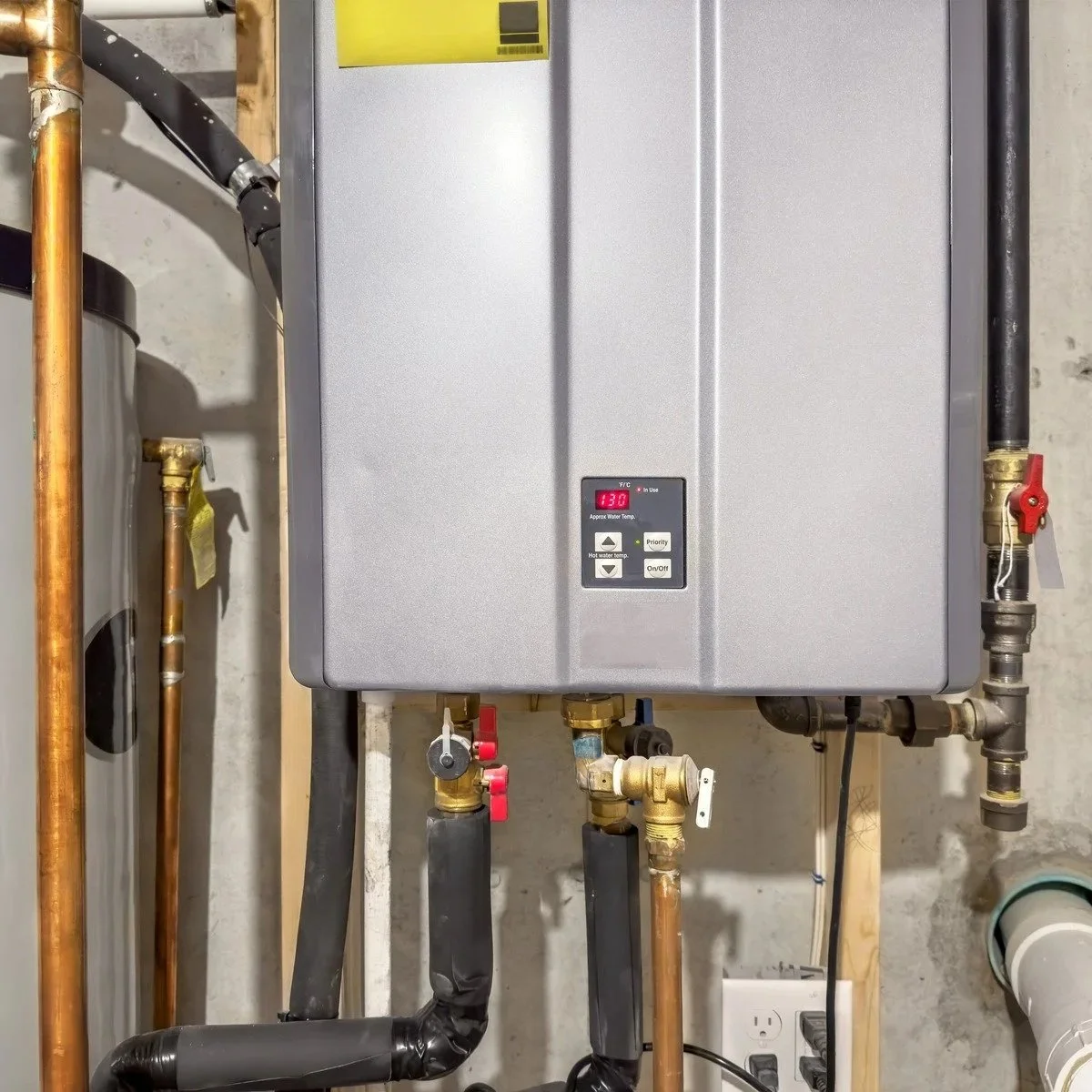
Your water heater is the appliance you never think about until the shower goes cold halfway through. When it finally fails, you're standing in the garage looking at a leaking tank and a decision you didn't plan to make this week: replace it with another tank, or switch to tankless. The two work in very different ways, and the better choice depends less on which is "newer" and more on how your household actually uses hot water.
How Each One Actually Works
A storage tank heater does what the name says. It holds water — 40 to 50 gallons cover an average household, though the Department of Energy notes that residential tanks hold anywhere from 20 to 80 gallons — and keeps it hot 24 hours a day with a gas burner underneath or electric elements inside. Drain it during a long shower, and cold water refills the bottom, which is why the hot water eventually runs out and then takes time to recover.
A tankless unit holds almost no water. When you open a hot tap, a flow sensor fires a powerful gas burner or bank of electric elements, and water races through a heat exchanger that raises its temperature on the way to the faucet. Stop the tap, and the unit shuts off. Nothing is kept hot in reserve, so the hot water doesn't "run out" the way a tank's does — but the unit can only heat so many gallons per minute, which becomes the real limit.
That difference — a reservoir you draw down versus a stream you heat on demand — drives everything else.
The Honest Side-by-Side
Neither type is better in the abstract. They trade strengths, and seeing them lined up makes the pattern clear.
| Factor | Storage Tank | Tankless |
|---|---|---|
| Up-front cost (unit + install) | Lower; usually a direct swap | Higher; may need gas, venting, or electrical upgrades |
| Typical lifespan (DOE) | 10 to 15 years | More than 20 years with maintenance |
| Hot water supply | Limited to tank size; runs out, then recovers | Continuous, but capped by flow rate in gallons per minute |
| Efficiency (DOE) | Loses heat around the clock (standby loss) | 24%–34% more efficient for average use; 8%–14% for heavy use |
| Space | Large footprint, needs floor space | Wall-mounted, frees up the closet |
| Hard-water upkeep | Flush sediment periodically | Descale yearly, more often in hard water |
Where Tankless Pulls Ahead
The headline advantage is hot water that doesn't quit. Fill a deep tub, run the dishwasher, and shower in sequence, and a tankless unit keeps delivering because it's heating a stream rather than emptying a reservoir. For a household that showers back-to-back on weekday mornings, that alone can settle it.
Efficiency is the quieter win. A tank reheats its stored water over and over to fight the heat slowly bleeding through its walls, even when nobody's home — that wasted energy is "standby loss." A tankless unit skips it by staying cold until you call for water. The Department of Energy puts the gain at 24% to 34% for homes using around 41 gallons a day or less, and 8% to 14% for high-use homes near 86 gallons a day. Pair that with a lifespan past 20 years against a tank's 10 to 15, and a wall-mounted footprint, and for a homeowner staying put a decade or more, the higher install cost starts to pay back.
Where a Tank Still Makes Sense
The tank's biggest edge is the price of getting started. The unit costs less, and the install is usually a direct swap — same connections, in and out. A tankless conversion can mean upsizing the gas line to feed that high-output burner, adding dedicated venting, or upgrading electrical capacity, and those changes push the project well above a like-for-like tank replacement.
Simplicity counts too. A tank has fewer ways to surprise you; every plumber knows the technology, and parts are everywhere. If you're replacing a heater in a home you plan to sell in a few years, the lower upfront cost often beats the savings from an upgrade you won't be around to collect.
Flow rate is the limit that people underestimate. A tankless unit is rated in gallons per minute, and the Department of Energy puts typical output at 2 to 5 gallons per minute, with gas units flowing faster than electric. Run two showers and the kitchen sink at once, and you can outpace a single unit, getting warm water instead of hot. A tank doesn't care how many taps are open until it's empty — it hands out whatever it already heated.
Don't Overlook the Other Two Options
Tank and tankless aren't the whole menu. A heat-pump (hybrid) water heater moves heat from the surrounding air into a tank instead of generating it directly, and the Department of Energy notes it can use far less electricity than a standard electric tank — a strong option in a warm garage. And among gas tankless units, a condensing model captures extra heat from its own exhaust for higher efficiency than a non-condensing one. If you want hot water faster at a far tap, a recirculation pump addresses the wait without changing which heater you pick.
The Hard-Water Factor That Changes the Math Here
This is where a Las Vegas Valley home has to think differently than a brochure assumes. Local water is among the hardest in the country — the regional supply runs about 16 grains per gallon (roughly 280 parts per million), classified "very hard." Those dissolved calcium and magnesium minerals drop out when water is heated and cling to hot metal as scale — the same chalky crust you see on a showerhead, forming where you can't.
In a tank, the scale settles to the bottom as sediment. It insulates the water from the burner, so the heater runs longer and louder and wears out faster, which is why flushing matters more here than in soft-water regions. In a tankless unit, scale is less forgiving still: it coats the narrow heat exchanger directly, choking flow and efficiency. Manufacturers call for descaling about once a year, and more often in water this hard. The 20-year lifespan is real, but here it's conditional on that upkeep.
The practical answer most Valley homeowners land on is to pair either heater with a water softener. Soften the water first, and you protect the heat exchanger, stretch the time between flushes, and keep the rest of the plumbing — fixtures, valves, the dishwasher — from scaling at the same time. A softener is what makes a tankless unit's long-life promise hold up in this climate.
So Which One Fits Your Home?
Picture how your household actually uses water. If several people need hot water in a tight morning window, you hate the idea of running out, and you're staying long enough to bank the energy savings, tankless rewards you, provided you commit to softening and descaling. If you want a lower up-front cost, a simple swap, a short timeline in the house, or peak demand that would outrun a single unit, a well-maintained tank is no compromise.
Sizing matters as much as type. Tanks are matched by first-hour rating — how much hot water they deliver in the busiest hour — and tankless by flow rate plus the temperature rise your incoming water needs. Get either one matched to your household and to this region's water, and the heater disappears back into the background where it belongs. That match is the part worth a professional's eyes before you buy.
Frequently Asked Questions
Does a tankless water heater really never run out of hot water?
Is tankless worth the higher cost in a hard-water area?
How long do tank and tankless water heaters last?
Can I switch from a tank to a tankless unit easily?
Why does my tank water heater make rumbling or popping sounds?
What size water heater do I need?
Match the Heater to How You Use Hot Water
Tankless and tank water heaters both deliver hot water well; they just suit different households. Tankless provides continuous hot water and a long lifespan in a small footprint, while a tank costs less up front and handles great simultaneous demand easily. Weigh your hot-water habits, space, and how long you'll stay in the home — and have the unit sized correctly — and either one will serve you for years.