
Trenchless vs. Traditional Sewer Line Replacement: What's the Difference?
A drain that backs up every few months, a soggy patch of yard that never quite dries out, a camera inspection that finally shows the real picture: a sewer line with cracks, root intrusion, or a bellied section holding standing waste instead of draining it downhill. Once a camera confirms the pipe itself has failed rather than a simple clog, the next question is how to fix it, and that answer used to mean one thing: trenching the entire yard, exposing the pipe end to end, and replacing it in an open cut. Now there's a second path that can solve the same problem from inside the existing pipe, with a fraction of the digging.
Neither method is automatically the better choice. What separates them is what the camera actually finds inside the line, how much of the yard sits above it, and how the two approaches age once they're buried again. Here's how they actually work, where each one fits, and what changes once the crew starts digging or feeding equipment down the line.
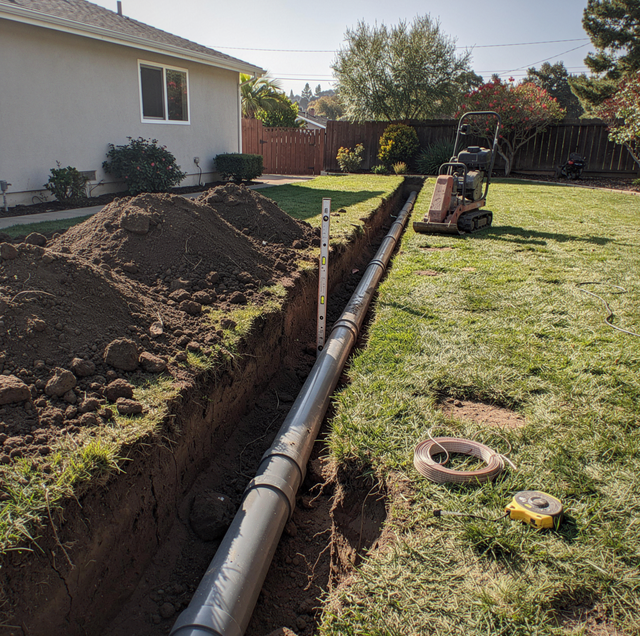
How Traditional Dig-and-Replace Works
Traditional replacement is exactly what it sounds like. A crew maps the pipe's path, then excavates a trench along that route, wide and deep enough to expose the full length of damaged pipe. The old pipe is removed in sections, new pipe is installed, joints are connected, and the trench is backfilled and compacted before the surface is restored.
The advantage of this approach is directness. Once the trench is open, every foot of pipe is visible. A crew can see a collapsed section, a low spot in the line, a joint that has separated, or root intrusion that has crushed the pipe wall, and address each problem on the spot rather than working around it. If the pipe's slope is wrong, meaning it doesn't fall consistently toward the connection point, digging it up is the only way to reset that grade correctly, since no method that works inside the existing pipe can fix the angle the pipe is buried at.
The trade-off is the trench itself. Grass, plants, hardscape, and sometimes a section of driveway or walkway above the pipe's path get disturbed, and depending on how deep the line runs, that disturbance can be a narrow strip or a wide swath. Expansive soil that shifts with moisture and heat can also make excavation and backfill more complex, since the trench must be properly compacted to prevent settling once the new pipe is buried and the soil dries out and contracts again.
How Trenchless Replacement Works
Trenchless methods replace or rehabilitate the pipe from the inside, using the existing line as the access path instead of digging along its entire length. Two techniques cover most trenchless sewer work, each solving different problems.
Pipe lining (cured-in-place pipe) works by inserting a flexible liner coated in resin into the damaged pipe, usually through an existing cleanout or a small access point. Once positioned, the liner is inflated against the interior pipe wall and cured, often with hot water, steam, or UV light, until it hardens into a smooth new pipe within the old one. Think of it like a cast forming inside a hollow tube: the resin takes the shape of the existing pipe's interior and sets rigid, sealing cracks, root-intrusion points, and small gaps from the inside. Lining works well when the original pipe still holds its shape and its slope, meaning the problems are cracks, leaks, and interior deterioration rather than a collapsed or badly misaligned section.
Pipe bursting takes a different approach for pipe that has failed more severely. A bursting head is pulled through the old pipe, physically fracturing it outward while a new pipe, usually a continuous length of a flexible plastic material, is pulled in directly behind it. The old pipe is destroyed as the new one takes its place. Bursting can handle a wider range of damage than lining because it doesn't rely on the old pipe's interior surface being sound. It can even upsize the diameter of the new line in some cases. It still needs a reasonably intact path to pull through, so a fully collapsed section or a pipe that has shifted out of alignment can stop the head partway through.
Both trenchless methods typically need only a couple of small access pits, one at each end of the run, rather than a trench spanning the whole distance. That's the core appeal: the yard between those two points stays largely undisturbed.
Trenchless vs Traditional Sewer Replacement: Side-by-Side Comparison
| Dimension | Trenchless (Lining or Bursting) | Traditional Dig-and-Replace |
|---|---|---|
| Yard and surface disruption | Limited to one or two small access pits; the run between them stays intact | Trench runs the full length of the damaged pipe, disturbing everything above it |
| Typical timeline | Often completed within a day once access points are dug | Usually spans multiple days between excavation, replacement, and backfill |
| Best-fit pipe condition | Cracks, root intrusion, and interior deterioration (lining); moderate collapse or the need to upsize the pipe (bursting) | Severe collapse, incorrect slope, major misalignment, or pipe that has shifted position |
| Access requirements | A working cleanout or small access point at each end of the run; a path the liner or bursting head can travel through | Enough yard, driveway, or ground clearance to open a continuous trench along the pipe's path |
| Longevity | A properly cured liner or a new pulled-in pipe can perform for decades under normal conditions | New pipe installed in an open trench has the same expected service life as the material used |
| Ability to fix pipe slope or grade | Cannot correct the angle the existing pipe was buried at | Full control over slope and position since the whole line is exposed |
Why the Camera Inspection Decides More Than Preference
A video inspection determines which method applies, not a general preference for less digging. The camera shows the interior condition of the pipe: whether it's cracked but structurally intact, whether roots have broken through at a joint, whether a section has flattened or collapsed, and whether the line holds a consistent downward slope or has developed a low spot where waste pools instead of flowing through.
Cracks, root intrusion, and interior corrosion in a pipe that still holds its shape are a strong match for lining, since the liner needs a stable surface to bond against. A pipe that has partially collapsed, or one that needs to be upsized to handle more flow than the original diameter allows, is more likely to burst, since the process can cause more damage and change the pipe's size along the way. A pipe that has fully collapsed, shifted out of alignment, or lost its slope in a low, expansive-soil area where ground movement has pushed a section out of grade generally rules out both trenchless options and points back to open excavation, since correcting the pipe's position is not something either lining or bursting technique can do from inside the line.
That's the practical filter: trenchless methods repair or replace the pipe in its current position, while traditional replacement can reset that position entirely.
What Access and Site Conditions Change
Even when a pipe is a reasonable candidate for lining or bursting on paper, the site itself sometimes settles the question. Trenchless work still needs a workable access point, usually an existing cleanout, at both ends of the section being repaired. If no cleanout exists near one end of the run, a small access pit gets dug to create one, which is still far less excavation than a full trench but is worth knowing about before assuming trenchless means zero digging.
Traditional replacement, by contrast, requires sufficient continuous access to the ground or hardscape to run a trench along the length of the damaged pipe. A line running under a mature tree's root system, a poured slab, or a section of driveway can make that excavation more involved, sometimes requiring additional work to route around or under an obstacle that a trenchless approach could simply thread past from the inside.
Depth matters too. A sewer line buried deeper than a typical residential run needs a deeper trench for traditional work, which adds time and requires more careful shoring for safety. Trenchless access pits stay relatively shallow and localized regardless of how deep the pipe runs in the middle of its path, since the equipment only needs to enter and exit the line, not expose it.
Weighing Cost Factors Beyond the Price Tag
Setting price aside, the practical trade-offs between the two methods come down to time, disruption, and what the pipe's actual condition allows. Trenchless work generally finishes faster because there's less excavation and backfill involved, and a completed liner or burst-in pipe is often ready for use again the same day once the access points are closed. Traditional replacement takes longer in most cases because it involves opening ground, replacing pipe section by section, and properly compacting the trench afterward so the surface doesn't settle unevenly over the following months.
Restoration afterward is a real factor too. A trenchless job leaves one or two small areas to patch and, if applicable, reseed or repair, versus a traditional job that may require reseeding, replanting, or repairing hardscape along the entire trench path. Neither factor alone should decide the method, since a pipe with the wrong slope or a fully collapsed section still needs to come out regardless of how much faster the alternative would be to complete.
Which Method Fits a Given Repair
The condition the camera finds inside the pipe, rather than a general preference for one method over the other, determines which approach applies to a specific repair. A cracked or root-damaged pipe that still holds its shape and slope is usually a strong match for lining. A partially collapsed section or a line that needs a larger diameter often indicates the risk of bursting. A pipe that has lost its slope, shifted position, or collapsed outright generally needs traditional excavation so the new line can be set at the correct grade from scratch.
A licensed plumber running a camera inspection can tell you which category your line falls into and walk through what each option would involve for your specific setup, including access points, expected disruption, and how the repair fits with the rest of your plumbing.
Frequently Asked Questions
How long does a properly installed sewer line typically last, trenchless or traditional?
Can tree roots come back after a trenchless repair?
Does a trenchless repair work on a pipe that has already partially collapsed?
Is one method generally faster to complete than the other?
Does the diameter of the sewer line limit which method applies?
What happens to the yard once either type of repair is finished?
Schedule a camera inspection — find out whether your sewer line qualifies for trenchless repair or needs traditional replacement. Much Better Plumbing serves Las Vegas and Clark County. Call (702) 996-4760.