
Repair or Replace a Garbage Disposal? The Part Decides
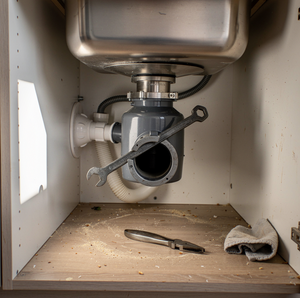
Flip the switch and the unit hums, low and flat, and nothing turns. Or the switch clicks and nothing answers at all. Or the cabinet floor under the sink has a dark ring on it that was dry last week.
Nearly every disposal complaint traces back to one of four parts: the flywheel that spins inside the chamber, the motor that turns it, the seals that keep water out of that motor, and the shredder ring the food is driven against. Only one of the four is a replacement every time. The other three split, and where they split is the whole of this decision. The question is which part is behind the noise, the silence, or the water.
The Hum Means the Motor Works and the Flywheel Does Not
A hum is good news. Current is reaching the motor, and the windings are energizing, so the motor is trying to turn, but something is stopping it.
There are no blades inside a disposal. A flywheel spins at the bottom of the chamber with two blunt impellers swiveling on it, and the impellers throw waste outward against a stationary shredder ring whose teeth cut it small enough to pass into the drain. When a fruit pit or a bone chip wedges between an impeller and the ring, the flywheel stops dead. The motor draws locked-rotor current for a few seconds, its thermal overload trips, and even the hum quits.
It is the most common disposal call there is, and a jam is almost always a repair, usually not even a part but a free-up.
Before anything goes near the unit, the power comes off twice. Turn off the wall switch, then open the breaker for the kitchen circuit. A disposal wired to a wall switch remains live at the unit until the breaker is open, because a failed switch can leave the unit energized. If the disposal is cord-connected to an outlet inside the cabinet, pulling the plug does the same job.
A jammed flywheel releases without warning, and a reset button already pressed leaves the motor armed. A unit that hums is drawing current, so nothing but tongs or needle-nose pliers goes into the chamber, and never a hand or a wooden spoon.
With the power off, a hex socket is located at the center of the disposal's underside. The wrench that shipped with the unit fits it, and a 1/4-inch hex key fits most. Work it back and forth in both directions until the flywheel turns freely, then look into the chamber with a flashlight and lift the obstruction out with tongs or needle-nose pliers. Restore power and press the reset button on the underside. That button and that socket are the only two points on a disposal a homeowner has any business touching. Anything that means loosening the mounting ring or opening the wiring cover is a plumber's work.
Silence Is a Power Problem Until Proved Otherwise
Nothing at all, not even a hum, means the motor is not being energized or can no longer energize. Four things produce that symptom, and the order matters, because the first three are quick and the fourth ends the unit.
Start with supply. Many disposals plug into an outlet inside the sink cabinet, and a tripped breaker or a plug worked loose behind stored cleaning supplies accounts for more dead disposals than any failed component.
Second, the reset. Every unit carries a thermal overload, with a small button on the underside that pops out when the motor is stalled or overworked. If it is standing proud of the housing, the motor tripped it, and seating it restores the circuit.
Let a tripped motor cool three to five minutes before pressing reset. The overload will not latch while the windings are hot, and repeated jabs at a warm button read as a dead unit.
Third, the switch. A wall switch is a mechanical device whose contacts pit and fail, and a switch that clicks with no response at the unit is a common and quick fix. Replacing it is electrical work rather than a disposal repair, and it belongs to whoever holds that license.
Fourth, the motor. If power is confirmed at the unit, the reset is seated, and it still does nothing, the windings or the overload have failed internally. Neither is field-serviceable. That unit is finished.
Where the Leak Starts Decides Repair or Replacement
Water under a disposal is the one symptom decided by height rather than by noise or age.
| Where the water shows | Part behind it | Verdict |
|---|---|---|
| Top, at the sink flange | Mounting seal and plumber's putty | Repair |
| Side, at the dishwasher inlet or discharge | Hose clamp or discharge gasket | Repair |
| Bottom of the housing | Internal shaft seal, water in the motor | Replace |
At the top, the disposal hangs from a mounting assembly that clamps the sink flange down through a bed of plumber's putty. Putty hardens and shrinks as it dries out, and the mounting screws back off under the vibration of every grind cycle. The leak appears as water tracking down the outside of the body or as a wet ring at the mount that appears only when the basin is filled. Pulling the unit, cleaning off the old putty, setting a fresh bead, and retightening the ring evenly fixes it.
On the side, the leak is a connection rather than a component. The dishwasher inlet is a nipple with a hose over it, held by a clamp; the hose stiffens, and the clamp loosens. Below that, the discharge tube bolts to the housing over a rubber or fiber gasket that compresses and weeps. Both are repairs, and neither one touches the disposal itself.
From the bottom, the answer changes completely. The motor sits under the grinding chamber, and a shaft seal keeps water in the chamber and off the windings. When that seal fails, water runs down the shaft into the motor and finds the lowest point of the housing, which is why the drip appears at the very base, often near the reset button. The seal is not a serviceable part on a residential unit, and water inside a motor ends that motor whether it quits this month or next. A leak from the bottom of the housing is a replacement, every time. It is the clearest replace signal a disposal gives.
Grinding and Rattling: An Object in the Chamber or a Worn Ring
A hard metallic clatter that changes as the chamber loads and empties is almost always evidence that something in there should not be. Bottle caps, a teaspoon handle, a pull tab, a shard of glass: any of them rides the impellers around the ring and hammers against it. Power off at the switch and the breaker, then lift it out with tongs. That is a repair, often a five-minute one.
The verdict changes if the noise survives an empty chamber. A shredder ring wears down from the teeth, and rounded teeth stop cutting and start pushing, so the unit runs louder, runs longer, and passes larger pieces into the drain. Impellers wear at their pivots and rattle loose on the flywheel. Bearings sound different again: a rising growl or whine that holds steady whether the chamber is full or empty, because it comes from the shaft rather than the load. None of those three is worth replacing on its own. They are not sold as service parts for most residential models, and reaching them means opening the housing the motor is pressed into. That is a replacement.
Slow Draining Points at the Line, Not the Disposal
A disposal reduces particle size. It does not push water. If the basin fills while the unit runs and empties slowly once it stops, the restriction sits downstream, in the trap, the trap arm, or the branch line the kitchen shares. A brand-new disposal on a restricted line backs up just as the old one did, making this the most wasteful misdiagnosis on the list: a working unit thrown out to fix a drain. A line that keeps closing back up after it is cleared is a drain diagnosis in its own right, starting at the trap arm with a cable or a camera.
Chemical drain cleaner belongs nowhere near a disposal. It sits in the chamber against the shredder ring and the metal housing instead of moving through, and it comes back at skin and eyes when the unit is finally run, or the trap is opened.
Age and Condition Override the Symptom
Most residential disposals give somewhere between about eight and fifteen years, and the spread comes from grade and workload rather than luck. A unit near the top of that range with a repairable fault is still a judgment call, because the seal, the bearings, and the ring behind that fault have all aged alongside it.
Whether it is still the original builder-grade unit matters more than the number. Builder-grade models run 1/3 or 1/2 horsepower with a galvanized steel grinding chamber and shredder ring and a low-torque induction motor, and they jam most, because less torque means less ability to drive through a hard load. Moving to 3/4 or 1 horsepower buys torque and a quieter motor. A stainless steel chamber and ring buys something else: resistance to the corrosion that eats a coated-steel chamber outward from the shredder ring, which is why mineral-heavy water shortens a coated chamber's life well before a stainless one's.
A second failure inside a short window is its own signal. One repair on an eight-year-old unit is maintenance. A second repair on the same unit within a year is the remaining parts saying they share those run hours.
Then there is the shape of the job. Almost all the work in a disposal call is the same regardless of what is being fixed: clearing the cabinet, taking the unit's weight, breaking the discharge and dishwasher connections, unseating the mounting ring. The unit is the small part of it. A repair that requires a full disconnect on a disposal already deep into its service life leaves you holding an old motor and an old seal, with very little saved.
Frequently Asked Questions
Yes, with two preparations. Clamp or pinch off the dishwasher drain hose first, or the pressure travels up that hose into the dishwasher, and block the second basin's drain so it goes down the line instead of across. Work the plunger with the unit switched off and enough water in the basin to cover the cup.
Cold. Cold water keeps fats and oils semi-solid, so the impellers throw them into the line as particles rather than smearing them into a warm film that sets on the pipe wall farther down. Hot water belongs in the dishwashing that follows, not in the grind cycle.
The odor usually is not in the chamber at all. It sits on the underside of the rubber splash guard and around the collar above the flywheel, on a film of residue nothing the impellers do ever reaches. Grinding ice or citrus will not touch it. On most units, the baffle lifts out, and scrubbing its underside and the collar with a brush is what clears the smell.
Every new unit ships with a solid knockout plug cast into the dishwasher inlet, and it has to be driven out with a screwdriver and a tap of a hammer before the hose goes on, or the dishwasher will not drain. The freed plug drops into the chamber and has to be fished out with tongs, or it becomes the rattle on the first run.
Fibrous strings are the worst offenders. Celery, artichoke leaves, corn husks and onion skins wrap around the impeller pivots rather than being cut. Starchy loads fail differently: potato peels, rice, and pasta pass through the chamber as a paste and set up in the trap arm downstream, so the unit sounds healthy while the sink drains more slowly every week.
The reset is a thermal device that answers a stalled or overworked motor. A breaker trip is a current fault that usually indicates a short inside the unit to its metal housing, or a circuit already loaded by another appliance. That is an electrical diagnosis before it is a plumbing one, and the unit stays off until it is made.
Get the disposal diagnosed before it gets replaced — knowing which part failed is the difference between a quick repair and a new unit. Much Better Plumbing serves Las Vegas and Clark County. Call (702) 613-8452.