
Backflow Test Failed? What Comes Next for the Repair
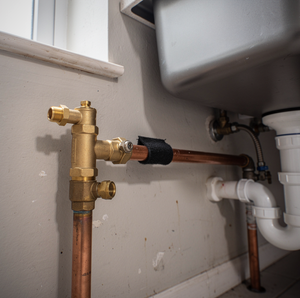
A failed backflow test is a finding about the assembly, not a finding about the water. It means the assembly that is supposed to stop backflow could not prove it would, on the day a technician ran the test. Inside the housing are one or two spring-loaded check valves (a single-check assembly pairs its check with an air inlet valve, and both are tested), and on some assemblies a relief valve that sits between them. The test measures whether each part holds the pressure difference it is built to hold. When a check valve lets pressure bleed past it, or a relief valve stays open when it should be shut, that reading indicates a failure and points to a specific part rather than the assembly as a whole. Reading the report the tester hands over shows which part is at fault before anyone opens the housing.
| What the Test Report Shows | What It Means |
|---|---|
| First check valve not holding | The disc in the first check is not seating fully, from a worn seat, a weakened spring, or something caught under it |
| Second check valve not holding | The second check's disc is not seating, from the same wear or debris as the first; either check failing fails the assembly |
| Relief valve discharging continuously | Either the first check is not holding, and the relief valve is opening as designed, or debris or a worn disc is holding the relief valve itself open; the test readings separate the two |
| A single reading that will not repeat | Debris or scale caught under a valve seat, which can clear itself between test cycles and then foul again |
What a Backflow Assembly Does
A backflow assembly is built to let water flow one direction, out toward the fixtures or irrigation it feeds, and to close the moment pressure tries to push water back the other way. The check valves inside do that work with spring-loaded discs that snap shut on a pressure reversal. A relief valve, when present, is a second layer: if a check valve does not close completely, the relief valve opens to release trapped pressure rather than letting contaminated water sit against a failed check. Under forward flow, the checks open against their springs and the relief valve stays shut; none of that shows whether the assembly would hold against a reversal. They only prove themselves during a reversal, which is exactly what the test is built to force and measure.
Which parts a report can name depends on the assembly type. A double-check assembly relies on the two check valves alone, with no relief valve between them, so a report on that type will only ever name a first-check or second-check failure. A reduced-pressure assembly adds the relief valve as a backup between the two checks, which is why a report on that type can also flag continuous discharge as its own failure mode. Knowing which type is installed tells you, before the report even arrives, which failure modes are possible for that unit. A single-check assembly, a pressure vacuum breaker, tests differently again: its one check valve is paired with a spring-loaded air inlet valve rather than a second check, so a failed reading on that type points to one of those two parts instead of a first- or second-check split.
Why a Backflow Test Fails
A worn disc, a tired spring, and debris are three reasons a check will not hold, and none of them is about the assembly's basic design. The rubber facing on a check valve's disc wears with every cycle it closes, and once it loses its shape, it can no longer seal against the seat. A spring that has weakened over years of holding tension closes its check more slowly, or not fully, letting pressure past before it seats. Grit, scale, or a piece of debris pulled in from the supply line can lodge under a seat and hold it open by a fraction of an inch, which is enough to fail a calibrated test even though the valve looks closed. Any one of these can happen on its own, and a single failed reading does not tell you which one until the housing is open.
Repairing or Replacing the Assembly
Repair is the first option for a failed assembly; it is tried before replacement. A worn seat or disc is rebuilt with new internal parts sized to that model, a fatigued spring is swapped, and a valve fouled by debris is cleaned and reseated. Replacement is the better call when the housing itself is corroded or cracked, when the assembly has failed the same way on back-to-back tests after a rebuild, or when the model is old enough that rebuild parts are hard to source. Deciding between the two is a judgment call made after the housing is open and the wear on the parts inside is visible, not something you can settle from the test report alone.
A backflow assembly sits under full system pressure, and opening the housing without isolating and draining it first can release water forcefully. Leave any disassembly to a plumber, who bleeds off pressure before removing a check valve or relief valve.
A repair visit starts with the technician confirming which check or valve the failed report named, rather than opening every part of the housing. The isolation valves on either side of the assembly are closed, and the housing is drained before anything is removed, which is what keeps the repair itself from becoming a second pressurized release. Once the worn part is out, the replacement is matched to the assembly's model and size rather than swapped for a generic fitting, since a mismatched seat or spring can pass a bench test and still fail the calibrated one once it is back on the line.
The Retest
A repaired or replaced assembly is not considered fixed until it passes the same test that flagged it, run again with a calibrated test kit. The retest checks each check valve's closing pressure and, where the assembly has one, confirms the relief valve stays shut under normal pressure and opens only when it should. A passing retest is what closes out the failure. Until that second passing report exists, the provider's record still shows the failed test, even after the physical repair is done, because the repair itself was never the thing being measured.
Keeping the Paperwork
Testing and reporting requirements for backflow assemblies are set by the local water provider, not by whoever repairs the unit. That means the paperwork trail- the failed report and then the passing retest- is what closes the loop with the provider, separate from the repair invoice. Keeping both reports together, the failed one and the passing retest, gives you a paper record that the assembly was found, fixed, and verified again, which is the record a water provider is checking for.
Hold on to the tester's report and note which check failed and whether the relief valve was discharging or only seeping. Handing that detail to whoever repairs the assembly can save a second trip to source the right rebuild kit.
Leaving a Failed Report Open
A failed report that never gets a passing retest behind it stays open with the water provider. What the provider needs on file to close it out, and in what form, is set by that provider. The repair and the retest are the two steps on the owner's side.
Frequently Asked Questions
Why does a reduced-pressure assembly need open space below its relief port?
The relief port discharges straight out of the housing and must remain clear of standing water or a hard drain connection, so discharged water cannot be drawn back in. That open gap is also why water lands on the ground or floor when the relief valve opens.
Can a technician run the test a second time before deciding it failed?
Yes, on the same visit. Trapped air in the line can skew a single gauge reading, so a technician can rerun the test once to rule it out. A failing result on the second pass confirms a part needs repair rather than a retry.
What does a technician use to test each valve?
A calibrated differential-pressure test kit connects to the test cocks built into the assembly. Gauges on the kit read the pressure difference across each check valve directly, allowing a technician to get a numeric pass or fail instead of judging it by eye.
Is an occasional drip from the relief valve automatically a failure?
Not on its own. A brief discharge when the supply pressure dips or fluctuates can be the relief valve doing exactly what it is built to do. Continuous discharge, or a failing reading during the calibrated test itself, is what counts against the assembly and is what a repair visit addresses.
What if the assembly is installed below grade in a vault?
The vault has to be opened, and any standing water pumped out, before a technician can reach the test cocks. That adds a step to both the original test and the repair visit that an above-ground assembly does not need.
Who keeps the paperwork after a passing retest?
When the provider accepts the tester's reports, the tester files the passing report, since the provider is the one tracking compliance. A copy of the same report is also worth keeping on your own as a receipt that the assembly was tested and passed, in case the provider's own copy is ever misfiled or requested again later.
Choose backflow repair and retesting — the assembly is rebuilt or replaced, then retested and the report filed with the water provider. Much Better Plumbing serves Las Vegas and Clark County. Call (702) 613-8452.