
Touchless Faucet Not Working? Sensor, Power, or the Valve
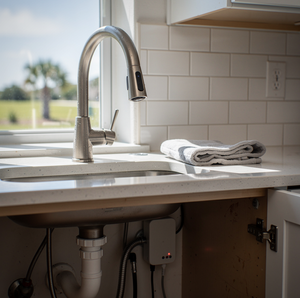
A touchless faucet is a plumbing fixture with an added layer of electronics. Underneath the sensor and control box sits a faucet body and mixing valve that work exactly like any other kitchen or bath faucet, blending hot and cold water and shaping the flow at the spout. Layered on top of that base fixture are a sensor that detects a hand near the spout, a control box that reads the sensor and decides when to open the line, and a solenoid valve that opens and closes the line on command. A battery pack or a plug-in adapter powers the electronics. When a touchless faucet stops responding to a wave, the fault lies in one of those links: the power supplying it, the sensor watching for a hand, the solenoid doing the opening, or the ordinary valve underneath it all.
Matching the symptom to the failing link narrows the list before any part gets tested:
| Symptom | Likely Link |
|---|---|
| No water and no indicator light | Power: dead batteries, an unplugged or failed adapter, or a tripped breaker or GFCI feeding the adapter |
| A blinking indicator light | Control box registering a fault code (varies by model) |
| Water runs on and will not stop | Solenoid stuck open, or the sensor reading a hand that is not there |
| Faucet turns on by itself | Sensor false-triggering on light, steam, or a reflective surface |
| Only a trickle from the spout | Solenoid only partly opening, or debris caught in its inlet screen |
| Works by hand but not hands-free | Sensor, control box, or solenoid, not the mixing valve underneath |
Power, Batteries and the Adapter
A touchless faucet's power source sits under the sink, out of sight until it fails. A battery-powered unit runs off a pack of cells housed in a small box on the supply line, wired to the control box and solenoid. A plug-in unit instead uses a low-voltage adapter plugged into a nearby outlet, stepping down household current to the voltage the electronics use. Either way, no light on the control box and no sound from the solenoid when a hand passes the spout puts power ahead of the sensor on the list. Dead batteries are one cause; a battery pack seated with the terminals not making contact, or corrosion on the contacts, are two more that look identical from outside the cabinet. A plug-in unit can lose power at the adapter itself, at the cord, or at the outlet it feeds from, including an outlet on a tripped GFCI or a breaker in the panel that has tripped. The low-voltage cable running from the adapter or battery box up into the faucet body is another potential point of failure: a connector pushed loose during under-sink cleaning, or pinched between the cabinet wall and a stored bottle, can cut power to the control box while the outlet upstream still tests fine. Before any hands-on check of the control box, close the two under-sink stops and, on a plug-in model, unplug the adapter first.
Household current at an outlet inside a wet sink cabinet is a shock hazard, and a cracked adapter cord or a loose outlet there is electrical work. A licensed electrician repairs outlets and wiring; a plumber handles the faucet side.
The Sensor Window and What Confuses It
Behind a small clear window in the spout sits the sensor itself, with an emitter and a receiver that reads light bounced back from whatever passes in front of it. A film of grime, a hard-water spot on that window, or a scratch across it scatters the light the sensor depends on and can make it stop registering a hand right in front of it, or register one that is not there. A highly reflective sink basin, a shiny faucet finish nearby, or direct sunlight hitting the window can each send the sensor a signal that looks like a hand is present when none is. None of that touches the plumbing underneath; a fouled or confused sensor window is an electronics problem sitting on top of a faucet that otherwise works.
Abrasive pads and harsh chemical cleaners can haze a plastic sensor window for good, and no later wipe reverses that haze. Plain water and a soft cloth lift grime from the window without marring its surface.
The Solenoid Valve and Its Inlet Screen
The solenoid is the part that turns a sensor's signal into water moving through the faucet. It is an electrically operated valve with a small plunger that lifts off its seat when current reaches its coil, opening a path for water on its way to the mixing valve and the spout. A fine screen sits at the solenoid's inlet to keep sediment out of that narrow opening, and water work done elsewhere on the line, closing and reopening the main, a repair on a nearby fixture, or a repiping job, can stir up debris that travels down and lodges in that screen. A partially blocked screen shows up as a trickle even when the sensor is working correctly and the solenoid opens on command; a solenoid stuck fully open is one fault that keeps water running after the sensor should have closed it. The coil itself can also burn out, leaving the plunger seated when the control box signals it to open, so the faucet stays dry even when the sensor is working.
Manual Mode and the Mixing Valve
A touchless faucet can include a manual override for filling a pot or running water without triggering the sensor: a handle, lever, or button separate from the sensor path that opens the valve directly. Testing that override narrows the fault in one step. Hands-free failure while the override still runs water places the fault in the sensor, the control box, or the solenoid, and clears the mixing valve and the faucet body beneath it. If the override also fails to produce water, the fault can sit in the parts an ordinary faucet has, the mixing valve, its cartridge, or a supply line, or, on a faucet whose override still feeds through the solenoid, in a solenoid stuck shut.
Water That Will Not Shut Off
Water that keeps running after a hand clears the spout calls for an immediate response before any diagnosis. Closing the two under-sink stops for that fixture cuts the flow at once without touching the faucet's electronics, and knowing where those stops are, along with the house's main shutoff, is worth confirming before any fixture fails this way. With the water stopped, the same fault list applies: a sensor stuck reading a hand, or a solenoid stuck open, either one holding the valve past the point where it should have closed. A control box that has locked into an open state after a power surge or a loose connection can produce the same result without either part being physically damaged, which is why the fix sometimes turns out to be the electronics rather than the valve itself once the stops are back off and the faucet is tested again.
Repairing a Part or Replacing the Faucet
Once the failing link is identified, the repair depends on how the faucet was built. On some models, the control box and the solenoid are sold as a single replaceable module, separate from the spout and the mixing valve, so a sensor or solenoid failure can be fixed without disturbing the plumbing underneath at all. On other, more fully integrated models, the electronics are sealed inside the spout casting itself, with no separate module to swap, which turns the same failure into a whole-faucet replacement rather than a part swap. Confirming which design is installed and matching a control box or solenoid to it determines whether the fix is a part or the faucet.
Frequently Asked Questions
Can a touchless faucet still be used if the sensor or control box fails?
On models with a manual override, yes: the handle or override control runs water through the faucet as an ordinary faucet while the sensor or control box waits for repair. On a model without one, a dead control box leaves the faucet unable to open.
Does a power outage stop a touchless faucet from working?
On a plug-in model, yes, unless the unit includes a battery backup. Some plug-in touchless faucets keep a battery pack wired in alongside the adapter specifically. Hence, the sensor and solenoid keep working through a short outage, and only stop once both the outlet and the backup battery are out.
What does a blinking indicator light on a touchless faucet mean?
It is a status signal from the control box, and each model sets its own pattern: a blink can flag a low battery on one faucet and a sensor or valve fault on another, so the same blink can mean different things on two faucets.
If the solenoid is the problem, does that affect the water temperature too?
No. The solenoid only turns flow on and off; temperature is still set at the mixing valve or the separate hot and cold handles beneath the electronics, the same as on a manual faucet, so a solenoid fault changes whether water runs, not how hot it comes out.
Why does a GFCI outlet matter for a plug-in touchless faucet?
A GFCI outlet cuts power when it senses current leaking toward ground, and a sink base, where water and the adapter share one cabinet, is where that cutoff protects anyone touching the faucet or the counter.
Can a touchless faucet go where a manual faucet used to be?
It can, as long as the sink deck has the holes the new faucet needs and the cabinet has room for the control box. A plug-in model also needs a nearby outlet inside that cabinet, and where none exists, adding one is work for an electrician; a battery model needs no outlet.
Enlist touchless faucet repair or replacement — sensor, power, and solenoid diagnosis, or a full replacement when the electronics are sealed in. Much Better Plumbing serves Las Vegas and Clark County. Call (702) 613-8452.