
Shutoff Valve Leaking When You Turn It? Repair or Replace
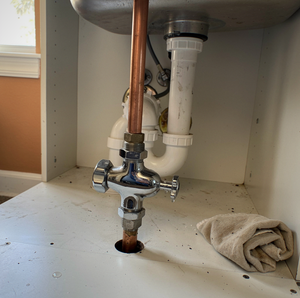
The small valve under a sink or behind a toilet is called a fixture stop, and it exists for one reason: to let you cut water to that one fixture alone, without closing off supply to any other fixture in the house. It sits open for years, sometimes for the life of the fixture, until a faucet repair or a slow drip finally calls for it, and that first turn is when an unexercised stop can start to leak. The packing seal around the stem has hardened in place, mineral deposits have formed a fine crust on the stem itself, or the internal washer has hardened from years of inactivity, so it no longer seals when it finally meets the seat. Turning the handle is what disturbs all three, so the leak that shows up is old wear meeting its first motion in years. Before an old stop is turned again after years without moving, the main shutoff's location is worth knowing; a steady leak from the stop means closing the main and calling a plumber.
Where the water shows up narrows the cause, and each location pairs with its likely cause and a repair-or-replace call:
| Where the Water Shows | Likely Cause | Repair or Replace |
|---|---|---|
| At the stem, only while you are turning the handle | Packing seal around the stem has dried or loosened | Repair: the packing nut can be snugged |
| At the stem even with the handle fully open and still | The packing leaks at rest as well as in motion | Repair if the nut still has travel; replace if it does not |
| At the compression nut where the valve meets the pipe | The nut has loosened, or its ferrule has deformed | Repair: tighten first; replace if the leak returns |
| At the outlet where the supply line connects | The outlet fitting or its washer has worn | Repair: reseat and tighten; replace the washer if it is flattened |
| The valve will not shut the water off fully | The internal washer or seat is worn past sealing | Replace |
Multi-Turn vs Quarter-Turn Stops
Fixture stops come in two designs and seal differently, which is why the same symptom can mean something different depending on which one you have. A multi-turn stop uses a threaded stem that drives a rubber or fiber washer down onto a seat, and a packing material around the stem keeps water from tracking out along the threads as it turns. A quarter-turn stop uses a bored ball that aligns with the pipe when open and turns crosswise against two seats to close, with an O-ring sealing its stem in place of packing. A multi-turn stop closes over several turns of its handle, a quarter-turn stop with one swing of its lever.
A multi-turn stop has adjustable packing, so a stem leak on one can be addressed by tightening. A quarter-turn stop's stem O-ring has no nut to adjust, so a stem leak on one is a replacement, and a leak at either end of it is a connection.
Packing Leaks at the Stem and Why Tightening Can Be a Temporary Step
A packing leak shows up as water working its way out along the stem, either while you turn the handle or, in a more advanced case, even with the handle left alone. The packing material, a soft fiber or rubber ring compressed around the stem just under the handle, is what keeps pressurized water from following the stem out through the body of the valve. Years of sitting in one position lets that material dry, flatten, or shrink slightly, and the first turn in a long while can be the moment it finally gives.
A packing nut sits just below the handle, and snugging it compresses the packing more tightly around the stem, which can stop a stem leak without draining the line; on an old stop, it is a plumber's adjustment, made with the valve body held still. This can buy real time, particularly on a stop that otherwise still closes fully and holds. It is a temporary step rather than a permanent one, because the packing material itself is still aged and will keep compressing less effectively with each cycle, and a stop that weeps again after one snugging has packing at the end of its life.
Connection Leaks at the Nut or the Supply Line
A different pair of leaks appears entirely away from the stem, at the two places where the valve connects to something else. The compression nut where the valve body meets the copper stub or pipe coming out of the wall can loosen over time, or the small brass or plastic ferrule it compresses can lose its seal after being disturbed. The outlet on the other side, where the flexible supply line threads on to run up to the faucet or toilet, has its own washer or O-ring, and that connection can weep even when the valve itself is sound.
Both of these are worth tightening before anything more drastic. Snugging the compression nut or the supply line's coupling nut, with the valve body held so it does not twist, can resolve the leak without touching the valve's internals. If the leak returns shortly after tightening, the ferrule or washer at that connection has likely failed and needs to be replaced rather than tightened again, since a compressed ferrule does not reset itself once it stops sealing.
A Valve That Will Not Close Fully Calls for Replacement
Tightening a nut or a packing gland assumes the valve still does its one job, shutting the water off completely when you need it to. A stop that leaks past the seat with the handle closed, so water keeps dribbling out at the faucet or trickling into the toilet tank even after you have turned it as far as it goes, has failed at the one function a shutoff valve exists to perform.
That failure is internal: the washer has worn thin or hardened past the point of sealing, or on a quarter-turn stop the ball or its seats have worn a path that no longer closes cleanly. Neither of those is something a wrench on the outside of the valve fixes. A valve that will not shut off fully is a valve to replace, not repair, because the part that seals is inside the body and getting to it means taking the whole stop apart, at which point a new stop also removes the risk of the old body itself being corroded.
When Stops Are Replaced Together
A single leaking stop is handled on its own, but a stop can also get replaced as part of other work rather than for its own leak. A faucet or toilet replacement is one such case: with the fixture already disconnected and the supply line off, swapping an old, stiff multi-turn stop for a new quarter-turn one can be done during the same shutdown, making the next repair easier to shut off. A stop that has corroded at the body, rather than just at the packing or a connection, is replaced outright, since a corroded valve body is not something a repacking or a tightened nut addresses.
A stop that has seized, meaning the handle will not turn at all even with steady hand pressure, falls into this category too. Forcing a seized handle risks snapping the stem, which turns a slow leak into water that will not stop until the main is closed, so a seized stop gets replaced rather than fought with.
A stem that will not turn past light hand pressure can shear off under added force, and a hot-side stop that lets go sends scalding water across skin. A plumber replaces a seized stop with the main closed.
How a Fixture Stop Is Replaced
Replacing a fixture stop starts away from the stop itself. The main shutoff for the house gets closed first, because a fixture stop sits between the main and the fixture, so there is no way to remove the old stop without cutting off water to that branch of the line. With the main closed, the supply line disconnects at the stop's outlet, the old stop is removed from the pipe or tubing stub to which it is mounted, and a new stop, which can be a quarter-turn design, is installed in its place.
From there, the supply line reconnects to the new stop's outlet, the main reopens, and the connections at both ends get checked under full pressure before the job is called finished. Replacing a valve this way, along with the supply line if it is original to an old stop, resets the weak point at that fixture rather than leaving a newer valve on an aging line that can still fail at the other end.
Frequently Asked Questions
Can a stop start leaking when nobody has turned it?
Yes. The connection nut at the outlet can shift when the supply line above it is bumped or pulled during cleaning under the sink, and the joint starts to weep even though the valve itself never moved.
Can a leaking stop be repacked instead of replaced?
On a multi-turn stop with a packing nut, yes: the packing around the stem can be renewed with the water off. On a stop old enough to leak at the packing, the washer and seat are the same age, which is what a plumber weighs when deciding whether to replace the whole stop.
Is it normal for a new stop to feel harder to turn than the old one did?
Yes. A new quarter-turn stop starts out stiff because its stem O-ring and ball seats are fresh and tight; one that will not turn at all under a firm hand is a faulty valve.
Could the leak be coming from the supply line instead of the valve itself?
It can, and the two look alike when everything is wet. With the area dried off, a paper towel wrapped around each joint in turn shows which one wets first.
Does a leaking stop mean the pipe behind the wall is also failing?
The stop and the pipe it is mounted on are separate parts, and replacing the stop does not call for opening a wall or floor unless the stub or supply pipe itself is visibly corroded. A stop replacement stays contained under the sink or behind the fixture when the supply pipe itself is sound.
Is a hot-side stop different when it has to come out?
It carries water at the water heater's setting, and closing the main does not empty it: the hot line still holds water at that temperature until a lower faucet drains it.
Hire shutoff valve replacement — a new quarter-turn stop and supply line under the sink or behind the toilet with the leaking valve. Much Better Plumbing serves Las Vegas and Clark County. Call (702) 613-8452.