
Low Water Pressure on the Hot Side Only: What It Rules Out
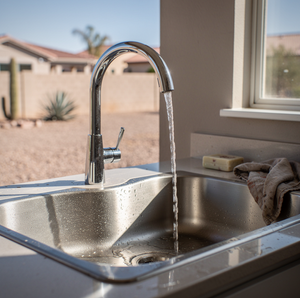
The kitchen tap runs cold water at full force and hot water at half of it. Same faucet, same moment, two very different flows. That pattern is narrower than it looks: whatever is throttling the hot water sits somewhere downstream of the point where the incoming line splits, because everything upstream of that split feeds both sides equally.
So a hot-only complaint has already cleared the meter, the main shutoff, and the pressure regulator before you call anyone. What is left is short, and every item on it sits on the hot path: the connections at your water heater, the heater itself, the hot branch leaving it, or the hot side of the one fixture where you noticed it. Your plumber sorts that list first.
Why Only the Hot Side Goes Weak While the Cold Side Holds?
Water arrives at a house on one line and leaves it in two networks. Up to the water heater's cold inlet, there is a single path, and a restriction in it is evident at every tap, hot and cold together. Past that inlet, the paths part: cold water carries on to the fixtures, hot water goes through the heater and out on its own pipe.
That geometry turns a symptom into a boundary. A weak hot side with a strong cold side is a one-branch restriction, not a house-wide one, and the two have almost no repairs in common. House-wide faults get solved at the main; one-branch faults get solved at the heater, in the hot pipe, or at one fixture. Knowing which you have saves you the other search entirely.
A second boundary sits inside the first. If your hot water is weak at every tap, the restriction stands before the hot pipe fans out, which puts your heater and its connections at the top of the list. If it is weak on one tap and normal at the others, the fault has moved to that fixture you use.
The Devices on the Incoming Main That Cannot Cause a One-Side Drop
A failing pressure regulator is the usual first suspect, and its symptoms are specific: low water pressure, no water pressure, or excessive water pressure, with water hammer heard in the walls or at the valve, and a hose or pipe that may even burst. Every one of those symptoms shows up in a home, with no hot or cold qualifier attached.
The reason follows from where the valve sits. A regulator, the main shutoff, and the meter all stand on the incoming line, upstream of the split, so whatever they do to the water they do to both sides of your house at once. If your cold taps are strong, you can set all three aside and spend your time past the split.
Restrictions Inside the Water Heater and at the Connections It Sits On
The two valves on a tank are at the cold inlet and the hot outlet, and both are on the hot path even though one carries cold water. A valve that was closed for a repair and reopened three-quarters of the way, or a flexible connector whose liner has collapsed inside its braid, throttles everything your heater sends out and touches nothing on your cold side. A hot-only complaint begins within arm's reach of the tank.
Inside the appliance, hard water is the mechanism: a tankless water heater needs less maintenance overall, but hard water minerals can still affect it. In a tankless unit, those minerals plate the narrow passages of the heat exchanger, and its flow drops with them. In a tank, they collect as scale around the outlet your hot water leaves by. A broken dip tube belongs to a different complaint: it shortens how long your hot water lasts.
None of that argues for turning your heater up. A higher setpoint does not widen a narrowed passage; it only makes the water that gets through hotter, and that reaches every tap in your house while the weak one stays weak. Descaling and sediment removal are service calls on a live appliance holding near-boiling water under pressure, and they belong to a plumber who can isolate and cool your tank.
Leave the thermostat where it is and have the restriction found, because raising a water heater's setpoint to compensate for weak hot flow raises scald temperature at every tap children use.
The Run of Pipe the Hot Side Keeps to Itself
Past the outlet, hot water travels its own pipe to every fixture in your building, and that network can differ from the cold one beside it in age, diameter, and fittings. A bathroom added later, a line rerouted around an obstruction, a branch extended to a new sink: a whole-home repiping job can take in upgrades, rerouting and additional fixtures. Any of them can leave your hot network tighter than the cold.
Scale that leaves a tank has only one direction to travel, and it is into your own hot branch. It comes to rest where the bore first narrows, which is usually a stop valve under a sink or the inlet of a fixture, and always on the hot side of that fitting. Your cold network never sees it.
Telling a One-Fixture Restriction Apart From a Hot-Branch Restriction
Sorting a one-fixture fault from a hot-branch fault is a comparison that takes a few minutes and no tools. Open the hot side alone at the weak fixture and watch the stream, then open the cold side alone at the same fixture and watch that. Move to a second fixture on another floor and repeat both. Three patterns come out of that walk, and each one points somewhere different. Weak on hot at every fixture points the fault back to the heater or the head of the branch. Weak on hot at one fixture while the others run full puts it at that fixture. Weak on both sides at one fixture puts it in the fitting the two sides share there.
An aerator packed with hard-water deposits is a fixture-level fault, and it throttles hot and cold together at that one tap, which is why it cannot account for a hot-only complaint.
A fourth pattern turns up often enough to name. Hot water that runs strong at the fixtures nearest the heater and weak only at the two farthest ones is a length-and-diameter problem in the branch itself, with no single failed part in it. Nothing you replace at the tap will change it, and nothing at your heater will either, which is why your plumber wants the whole walk instead of one reading at a single fixture.
What a Plumber Checks First on a Hot-Only Pressure Complaint
A plumber given a hot-only complaint works the path in order. The valves at your heater are fully opened and confirmed; the flexible connectors are felt for any soft collapse that shows nothing from outside; and the outlet side is compared against the inlet. Only after that does the search move out into your branch, and only then to the fixture where you first noticed the drop in hot flow.
The order matters because it changes which part gets replaced. The standard is simple: a water heater should never be replaced when a proper repair can salvage it. A restriction traced to a valve or a connector is a part swap beside your tank; the same symptom charged to the appliance is a whole new heater.
Frequently Asked Questions
Compare the two sides at the same tap, then at the tap farthest from your heater. Add the washing machine's hot fill to that comparison, since an appliance filling slowly on hot puts your fault out in the branch rather than at a single fixture in the house.
Usually not. A softener normally sits on the incoming line ahead of the split, so a fouled bed weakens both sides alike. The exception matters: some installs feed the heater alone from the softener, keeping minerals out of it. On that arrangement, the softener has moved onto your hot path, and a restriction inside it reaches your hot taps and none of your cold ones.
The logic holds; only your parts differ. Electric, gas, solar and tankless are the four common water heater types, and the first three keep a tank where sediment collects. A solar system adds a collector loop and its own valves, so your hot path carries more devices that can restrict your flow.
Mineral fouling arrives slowly. It shows up as a drift over months, noticed when an old shower no longer feels the way you remember. Valve and connector faults arrive between one day and the next. A hot side that went weak within a week of work on your plumbing points at the work before it points at your water.
It can be: a leak on your hot branch bleeds flow from that side alone. The signs to watch for are a stained ceiling or damp wall, the sound of dripping, a wet odor, moist carpeting, and a water bill that climbs with nothing in your house explaining it.
Because the case for repiping is a whole-system one, not a symptom-by-symptom one. Age matters: plumbing at 40 years or older is a candidate in its own right. Repeat trouble matters too, including low water pressure, repetitive clogs, or several leaks. So does pipe material: lead or galvanized steel pipes should be replaced promptly and without exception. Age, repeat trouble, and pipe material are properties your house has, so a hot-only symptom argues for finding your restriction first.
Book a short diagnostic visit — a weak hot side next to a strong cold side is a restriction with an address, and the visit ends with one part named and the rest of the system ruled out. Much Better Plumbing serves Las Vegas and Clark County. Call (702) 613-8452.