
Why Does My Water Pressure Drop When Two Faucets Run at Once?
You are in the shower with decent pressure, someone starts the kitchen faucet or flushes a toilet, and your shower instantly drops to a sad trickle. The moment they shut it off, your pressure comes back. If you have ever played this game with the rest of your household, you know how annoying it is, and you have probably wondered whether it is normal or a sign of a real problem.
A little drop when two fixtures compete is normal. A dramatic one is not, and it points to a specific limitation in your plumbing that is worth understanding, because the fix depends on which limitation you have.
It's Really a Volume Problem, Not a Pressure Problem
Here is the key insight: when your pressure tanks the moment a second fixture opens, the real issue is usually volume, or flow, not pressure by itself. Your pipes can only deliver so much water at once. When one fixture is running, all of that capacity is available to it. When two run together, they split the available flow, and if your system is already near its limit, both drop noticeably. A healthy system has enough capacity that two fixtures barely affect each other; a restricted one does not. So the question becomes what is limiting the volume your pipes can deliver.
The Usual Culprits Behind the Drop
A few specific restrictions cause most of this, and they narrow the effective size of your pipes or the supply feeding them.
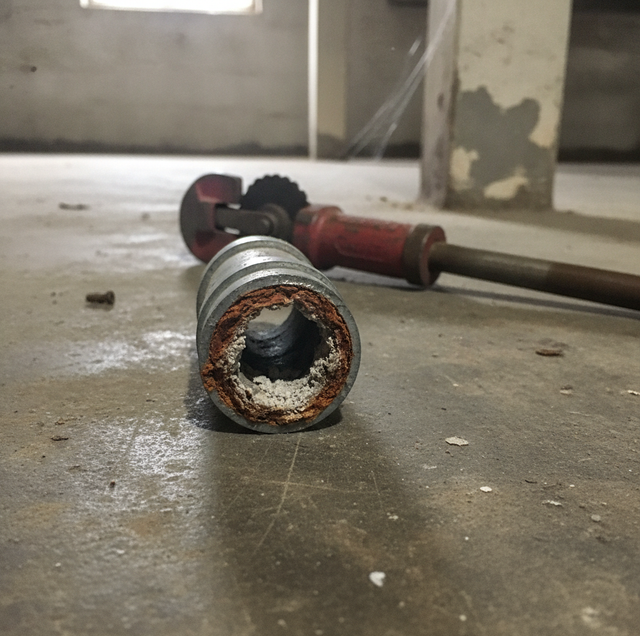
Corroded or scaled pipes are a leading cause, especially in older homes and hard-water areas. Over the years, mineral scale and corrosion build up on the inside walls of the pipes, narrowing the channel through which water flows. The pipe looks the same size from outside, but inside, the opening has shrunk, so it can carry less water at once, and running two fixtures reveals the limit that a single fixture hid.
Undersized supply lines are another. If the main line or the branch lines feeding your fixtures are too small in diameter for the demand, there simply is not enough capacity for two fixtures to run well together. This is sometimes an original construction issue and sometimes the result of a repair using the wrong pipe size.
A failing pressure regulator or a partly closed valve can also throttle the whole house, and a hidden leak bleeds off flow before it reaches your fixtures. Each of these limits the total water available, so the shortage only shows when demand doubles.
| What you notice | Likely cause |
|---|---|
| Long-time home, pressure fades with age | Scale or corrosion is narrowing the pipes |
| New construction or after a repair | Undersized supply lines |
| Whole house weak, both hot and cold | Failing regulator or partly closed valve |
| Drop plus higher bills or damp spots | A hidden leak is bleeding off the flow |
Why Hard Water Is Often the Hidden Reason
In a hard-water region, the scale-narrowing cause is the most common of all, and it is worth understanding why. Hard water carries a very high mineral load, and as that water flows through your pipes year after year, calcium and magnesium deposit on the interior walls and build into a scale layer that steadily shrinks the opening. Think of it like plaque narrowing an artery: slow, invisible from outside, and steadily reducing how much can flow through. Eventually, the pipes carry enough for one fixture but choke when two compete, which is exactly the symptom you are seeing. The same hard water also scales up fixtures, aerators, and the water heater, so the two-faucet pressure drop is often one sign of a whole-home scale problem. Treating the water and, where needed, addressing the scaled pipes is what restores steady flow for good.
Frequently Asked Questions
Is it normal for water pressure to drop when two faucets run?
Why does my shower lose pressure when the toilet flushes?
How can I tell if a shared branch or the main line is the problem?
How do I know if my pipes are corroded or just undersized?
How do I confirm that the pressure regulator or a hidden leak is to blame?
Can a leak cause pressure to drop with multiple fixtures?
Fix the Restriction, Not the Symptom
When your water pressure collapses the moment a second fixture opens, you are seeing a volume limit, not a simple pressure problem, and it usually traces to pipes narrowed by scale or corrosion, undersized supply lines, a failing regulator, or a leak. In a hard-water area, scale building up inside the pipes is the most common reason, which is why treating the water and addressing the affected pipes is what restores steady flow. Find the restriction, and the two faucets can finally run without a fight. And because the same scale that chokes the pipes also shortens the water heater and clogs the fixtures, clearing the cause often improves the whole home at once.